
By Kelly Damor, RN/BSN. Founder of Go Boundless Travel.
If you’re typing “is India safe for kids” into Google at eleven at night, I want you to know you’re in the right place. Because I asked the same questions. Before I had kids, before I met my husband, and before I lived in India for two years in my early twenties, I sat with the same picture in my head most Americans grow up with. Chaos. Dirt. Illness. Things going wrong far from home. So I get why you’re Googling.
But, despite all of that, I’ve been going to India for twenty years now. I’m Kelly, a registered nurse, and my husband, ND, grew up in India. We have two boys who started coming with us to India when they were small and we’ve never stopped going back. So when I tell you that India is safe for your kids, and that taking them is worth every bit of the work it takes to get there, I’m not telling you from a brochure. I’m telling you from inside it.
Here’s the part most people get wrong, including me before I went. “Is India safe for kids” is almost never the question someone is actually asking. There’s a different question underneath, and once you see what you’re really afraid of, the answer gets a lot clearer.
So let me walk you through it. What’s actually risky. What’s just unfamiliar. The things that have gone wrong for us, because plenty have. And what I’d want a close friend of mine to know before she got on the plane with her kids.
What people are actually afraid of
India does get portrayed as chaotic, dirty, and dangerous. And honestly, it can be all three of those things. It can be dirty. It can be chaotic. It can be dangerous.
But it’s also one of the most rewarding places in the world, and it will show you things about yourself and other people that you genuinely cannot find anywhere else, if you let it.
The real fear underneath the question isn’t actually about the chaos or the food or whatever specific thing has someone worried. It’s about being in a place that is profoundly different from what you’re used to. It’s the discomfort of not being in control.
I’ll give you an example. Someone close to me came to visit us in India early in my relationship with ND. They were terrified before they even got off the plane. We stayed in a nice hotel in Delhi, and that was the only place they really felt okay. Anytime we went out, they were nervous. The Taj Mahal was the one thing they enjoyed, and we got there in a private taxi. When we visited ND’s family home in Ajmer, which is a humble house, they didn’t sleep (there was a lizard in the room), didn’t eat, wouldn’t use the bathroom.
That’s a person who loves me, came with the best of intentions, and still missed the trip. Not because India failed them. Because they couldn’t stop being afraid of what was different long enough to be in it.
I bring this up because I think a lot of parents asking “is India safe?” are worried about the same thing without realizing it. And I want you to know that the discomfort of difference is not the same as danger.
The food and water question
This is the number one fear, so let me actually answer it.
For drinking water, we stick to sealed packaged bottled water. Hotels often offer RO (reverse osmosis) filtered water, and a lot of it is fine, but the quality varies. We’ve had stomach issues from RO water before. As a comparison: at the JW Marriott in Delhi, the glass-bottled water has been consistently good. At a Ramada in Udaipur where we stayed, we found particles in the RO water in the room. Both are technically “filtered.” They are not the same product.
If you’re going to India for two or three weeks for the first time, I’d skip the RO entirely and stick with sealed bottled water for everything, including brushing your teeth. We’ve been so many times that we’re a little more relaxed, but for a first trip, the conservative call is the right one. Remind your kids every single time not to drink the water in the shower. Every time.
For food, we eat at mid to upscale restaurants and we mostly avoid street food. There are exceptions, but as a general rule, that’s the riskiest food category. ND, who grew up in India, ate a samosa once from a small village stand on the way to a camp in Nepal. He thought his stomach could handle it. He regretted it for several days. The samosa was probably several days old. Even people who grew up there get caught.
We’re more relaxed about fresh fruit and vegetables than most travel guides recommend, especially at decent restaurants. But for first-time travelers, the standard advice (only peeled fruit, only cooked vegetables) is reasonable.
A few practical things from our family: we take Airborne or Vitamin C in the days before we travel. We bring a lot of Pepto. We pack electrolytes, because Indian food is heavy and people don’t drink water there the way Americans do, so you have to actively work at hydration. We bring fiber gummies because the food can either send things in one direction or stop them entirely. Both are normal. Plan for both.
When things actually go wrong
Things will go wrong. That’s not specific to India. That’s travel. The question is whether you can handle it, and the answer is yes, more easily than you think.
When Micah got sick from the shower water, we were heading into a rural area in Nepal the next day, with no clinic nearby and a tight schedule. So in addition to Pepto and hydration and the bland food (bananas, toast, biscuits, which is what crackers are called there), I gave him a course of azithromycin. Antibiotics are easy to get over the counter in India. As an RN, I made the call that the potential benefit was worth it for that specific situation. Most of the time we don’t reach for antibiotics. Most stomach issues clear up in a couple of days with rest and fluids. But in that case, with where we were going, I felt good about the decision.
Caleb had frequent ear infections as a toddler. On his first trip to India at two years old, he got one. We found a local clinic, saw a doctor, and got the medication. The whole thing, doctor visit and antibiotics included, cost less than ten dollars. The care was competent, fast, and unfussy. He was fine within a couple of days.
I’m telling you this not to suggest you should self-medicate your kids in foreign countries, because that’s a decision every parent makes based on their own knowledge and their own context. I’m telling you because the picture in most American parents’ heads is that getting medical care in India means a crisis. That’s not true. The medical system there has resources, pharmacies are accessible, and most things you’d encounter on a family trip are handled the same way you’d handle them at home, often faster and cheaper.
Things happen. You can manage them.
What I’ve actually been through in India
Let me just give you the list. In the two years I lived in India before I was a mom, I had bed bugs. I had lice three separate times. I had food poisoning so bad I am genuinely going to spare you the details, but it was thorough and it was repeated.
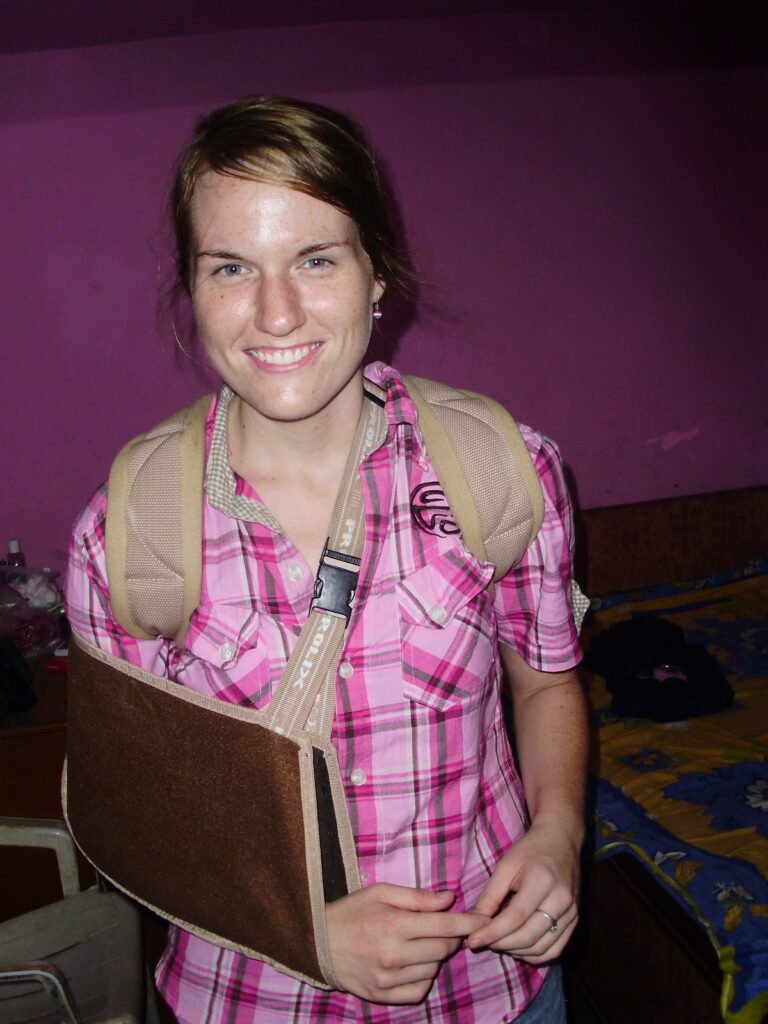
I once got so dehydrated and run down that I passed out standing at a metro station in Delhi. I fell hard enough to break my scapula and then spent the next two weeks trying to give myself a bucket shower with a broken shoulder blade in a guest house that I would not call a nice one.
Another time I got a kidney stone too large to pass on its own and ended up needing a quick surgical procedure. I ended up overnight in a general medical ward in Ajmer, the only white American in the room, no privacy, someone running down to the hospital pharmacy to physically bring back the medication so the nurse could administer it. It was quite an experience, but I’m still here to tell you about it.
Early on, I tried malaria pills, but the side effects were so intense I stopped, and I haven’t taken them since.
Then we had kids and we kept going.
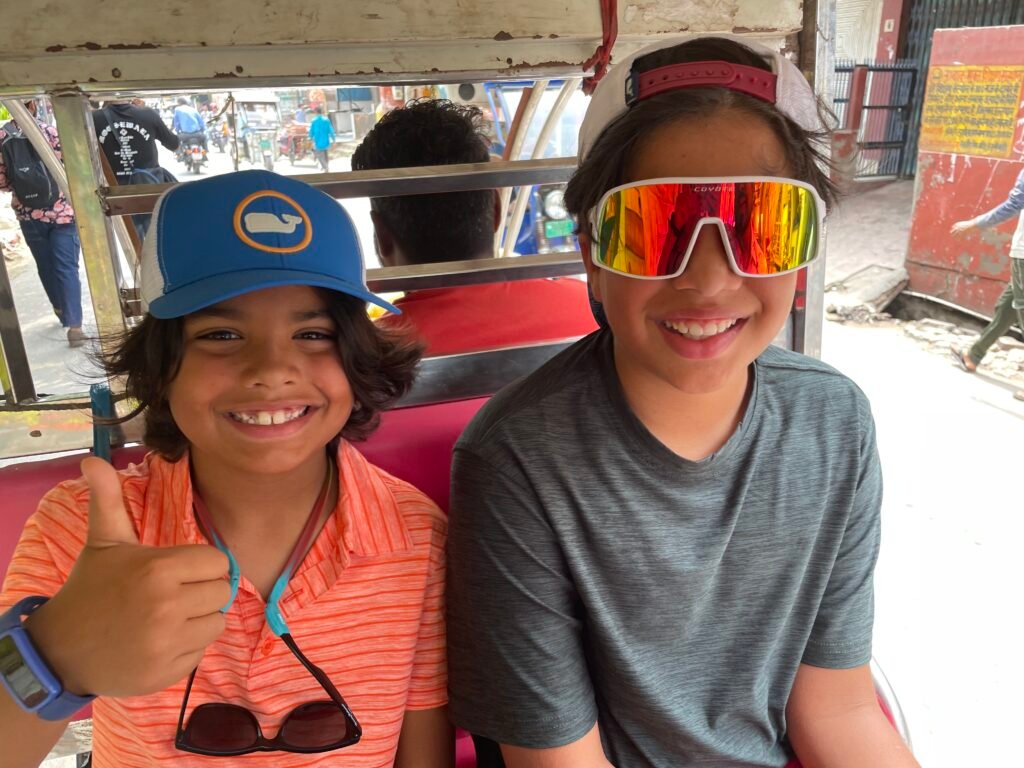
Micah’s first trip to India was at four years old. He has been a bad sleeper since the day he was born, and the jet lag was something else. I have photos of him asleep sitting up at dinner. Asleep in an auto rickshaw with his mouth open. Both of our boys have had Delhi belly multiple times. One time, Micah drank the water in the shower at eleven years old and got diarrhea from it. They’ve gotten car sick on mountain roads and we’ve all had more colds than we can count.
I don’t list all of these to scare you. I list them to tell you that things happen, and you can overcome them. All of this has happened and yet we still go back because the people, the culture, the experience is worth it.
The cultural stuff that scares Americans but isn’t actually unsafe
The crowds. The horns. The staring. The driving. The lack of personal space. These are the things first-time travelers describe as scary, but they’re not actually dangerous, and confusing them with danger is one of the biggest mistakes you can make on a trip to India.
Personal space is a privilege we know as Westerners. It’s not a reality for a lot of people in the world. India and Nepal will pack fifteen people into a five-seater car because everyone needs to go and they will, as our Indian friends say, “adjust.” We always laugh because they’ll tell us to adjust when more people are getting in a car or sleeping in a room, and it’s much harder for us than it is for them. We’re the ones who can’t adapt. Not the other way around.
Staring isn’t rude in India. It’s curiosity, and it’s accepted. People will stare at you, especially if you look different, and especially at your kids. It is not aggression. Don’t take it personally, because it isn’t.
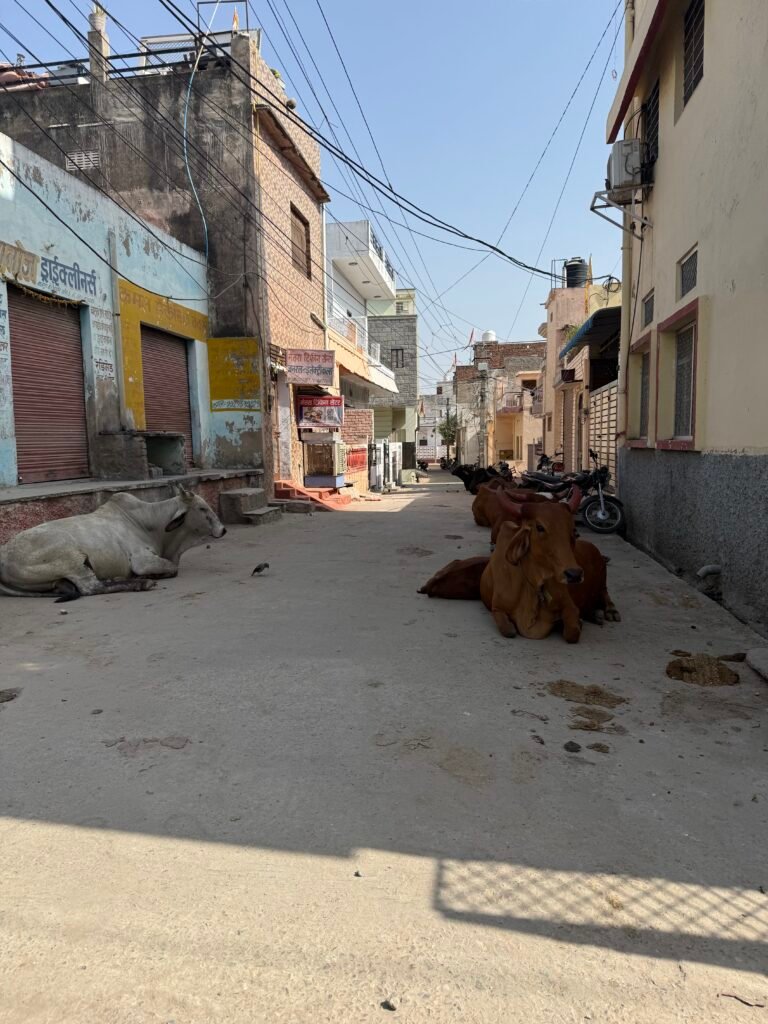
The honking is not anger. The horns mean “hey, I’m here.” They’re a tool of presence on roads where lanes are suggestions and pedestrians, cows, motorcycles, rickshaws, and trucks are all sharing the same six feet of pavement. You’ll watch five strangers cooperate to get two cars past each other in a gap an American driver wouldn’t even attempt, and there’s a cow lying down in the middle of it. It’s not chaos. It’s a different kind of order.
Going in with that framing, that the differences are differences and not threats, is half the work of having a good trip.
What I actually want you to know
If a close friend of mine were taking her kids to India for the first time, here is what I’d want her to walk away believing:
People live this way. They live full, beautiful, complicated lives in this place. Who are we to say we can’t handle a few weeks of it?
Yes, there are real risks, and yes, you mitigate them. You drink the right water, you watch the food, you bring the Pepto, you pace your days, you don’t put your kids on a fifteen-hour bus ride on day two. You prepare honestly with someone who has been there.
But the actual cost of taking your family to India is discomfort, and discomfort is not danger. Discomfort is the price of admission for meeting people whose lives don’t look like yours, eating food you’ve never eaten, seeing landscapes that will rearrange you a little, and showing your kids that the world is bigger and more layered than the version they get at school.
It’s the price of letting your worldview crack open a little. And it is one hundred percent worth it.
Once you’ve decided to go, the next question is usually timing. Here’s my honest season-by-season guide to the best time to visit India with kids. For everything else you need to plan your first family trip to India, including safety, food, costs, and where to go, read our full India Family Travel Guide.
What’s next
If you’re starting to think about a trip like this for your family, here are two ways we can help.
Free: The Asia Family Packing Guide
The first thing most parents need is a clear sense of what to actually bring. We put together a free guide covering exactly what we pack for our family across India, Nepal, and Vietnam. Real items, real reasons, no fluff.
Custom: A Travel Blueprint built for your family
When you’re ready to plan an actual trip, we design Custom Asia Travel Blueprints around your specific family. Your kids, your dates, your worries, your budget. ND brings the firsthand knowledge of growing up in India and the ability to make a call and ask the right person when something specific comes up. I bring the family travel prep lens and twenty years of going back. Every Blueprint includes a thirty-minute call so you walk away understanding the why behind every decision, not just the what.