
By Kelly Damor, RN/BSN. Founder of Go Boundless Travel.
If you’re planning a first family trip to India, the timing question hits early, and the honest answer comes in two parts.
The ideal window is October through March. The weather is mild and dry, the big sights are comfortable instead of punishing, and it’s the easiest season to travel with kids by a wide margin. If you have any flexibility at all, go then.
But here’s the part most “best time to visit India” articles skip. Most American families don’t have that flexibility. Your kids are in school, and the only real window you’ve got is summer, which happens to be India’s hardest season. Hot in a way that’s hard to explain until you’ve stood in it, with the monsoon arriving right behind it.
I’m Kelly, a registered nurse. My husband ND grew up in India, and we’ve taken our two boys across the country in nearly every season over twenty years of going back. So I’m going to give you both answers. When India is genuinely easiest. And how to make a summer trip work anyway, because we’ve done it more than once, and it’s very doable once you plan around the heat instead of pretending it isn’t there.
The short answer, if you have the choice
October through March is the stretch where India makes it easy on you.
The days are mild, the nights are cool, and the heat that runs the rest of the year just isn’t there. In the north, where most first trips go, November through February is genuinely comfortable. You can walk the grounds at the Taj Mahal, climb through the forts in Rajasthan, and spend a full day out in Delhi without anyone melting down. That matters more than it sounds, because the fastest way to lose a kid on a travel day is to march them around in heat they can’t get out of.
It’s also the dry season, so you’re not planning your days around afternoon downpours or wondering whether the road between two cities is washed out. With kids, predictable is worth a lot.
The tradeoff is that everyone else knows this too. December and January are peak season, which means the famous places are more crowded and the good hotels cost more and book up earlier. If you can aim for late October, November, or early March, you get most of the good weather with thinner crowds and better rates.
And India is not one climate. The window that’s perfect for the Golden Triangle is not the window that’s perfect for the Himalaya or the far south, which I’ll get into below. But if you want the single safest bet for a first trip with kids, it’s the cool, dry months.
Season by season, honestly
The cool months I already made the case for, so I’ll just add the part the guides skip. In the north, winter nights actually get cold, especially in the desert. Rajasthan in December can be in the forties by morning, and a kid who packed only for “hot India” is going to be miserable at 6am waiting to get into a fort. Pack a real layer. The days are lovely. The mornings and evenings are not.
Summer is the honest hard one. From April into June the northern plains, which is where the Taj Mahal and most of Rajasthan sit, climb past 40C, and by May it’s regularly over 110F. That is not “warm.” That is the kind of heat where you cannot sightsee at midday, where a child wilts in twenty minutes, and where the whole day has to bend around staying cool and hydrated. I’m not going to pretend it’s pleasant, because it isn’t. If you have the choice, this is the window to avoid for the classic first-timer route.
Here’s the catch, and it’s the reason this whole post exists. Summer is also when your kids are out of school, which makes it the only window a lot of American families actually have. So the real question isn’t whether summer is hard. It is. The question is how to do it anyway, and that has a good answer, which is the next section.
The monsoon, roughly July through September, is the season people fear for the wrong reasons. Yes, it rains, sometimes hard, especially on the west coast and down in Kerala, and yes, you’ll catch the occasional delay or flooded street. But it’s also green in a way the dry months never are, the crowds thin out, and the prices drop. Parts of the country sit in the rain shadow and stay dry straight through it, which matters a lot for where you point a summer trip. The rain isn’t the enemy people make it. It’s just something you plan around instead of getting caught by.
The summer problem
If summer is your only window, let me say the reassuring thing first, because it’s true: you can do this. We’ve done a summer trip many times, and we’re going again this July. It is not the easy season. It is a survivable one, and survivable is all you need when school picks your dates for you.
You have two ways to play it.
The first is to dodge the heat entirely. Summer is actually the best season for the Himalaya and the hill stations, places like Shimla, Manali, and Dharamshala, where the plains heat never reaches and Indian families go specifically to escape it. If you’re flexible on where you go, pointing a summer trip up into the mountains or down toward the cooler south is the easy answer, and it’s a good one.
The second is the one most first-timers actually want, which is to see the classic route anyway. The Taj Mahal. Rajasthan. The Golden Triangle. You can absolutely do it in summer. You just have to build the whole day around the heat instead of pretending it isn’t there.
Here’s exactly how we do it. Handheld fans for everyone, not optional, one per person. Frequent AC breaks built into the plan, not left to chance. We pick the restaurant we’re heading to in advance, so there’s always a known cool place to aim for instead of wandering around melting. We take taxis or Ubers instead of auto rickshaws, partly just for the AC, because an open auto in May is only more heat. And we split the day in half: out early, indoors and cool through the worst of the afternoon, back out when it softens in the evening.
One honest addition: cooling towels. They’re new for us this July, and I genuinely don’t know why it took us this many summers to start bringing them. I’m packing them this time, and if you’ve somehow gone without them like we have, consider this your reminder.
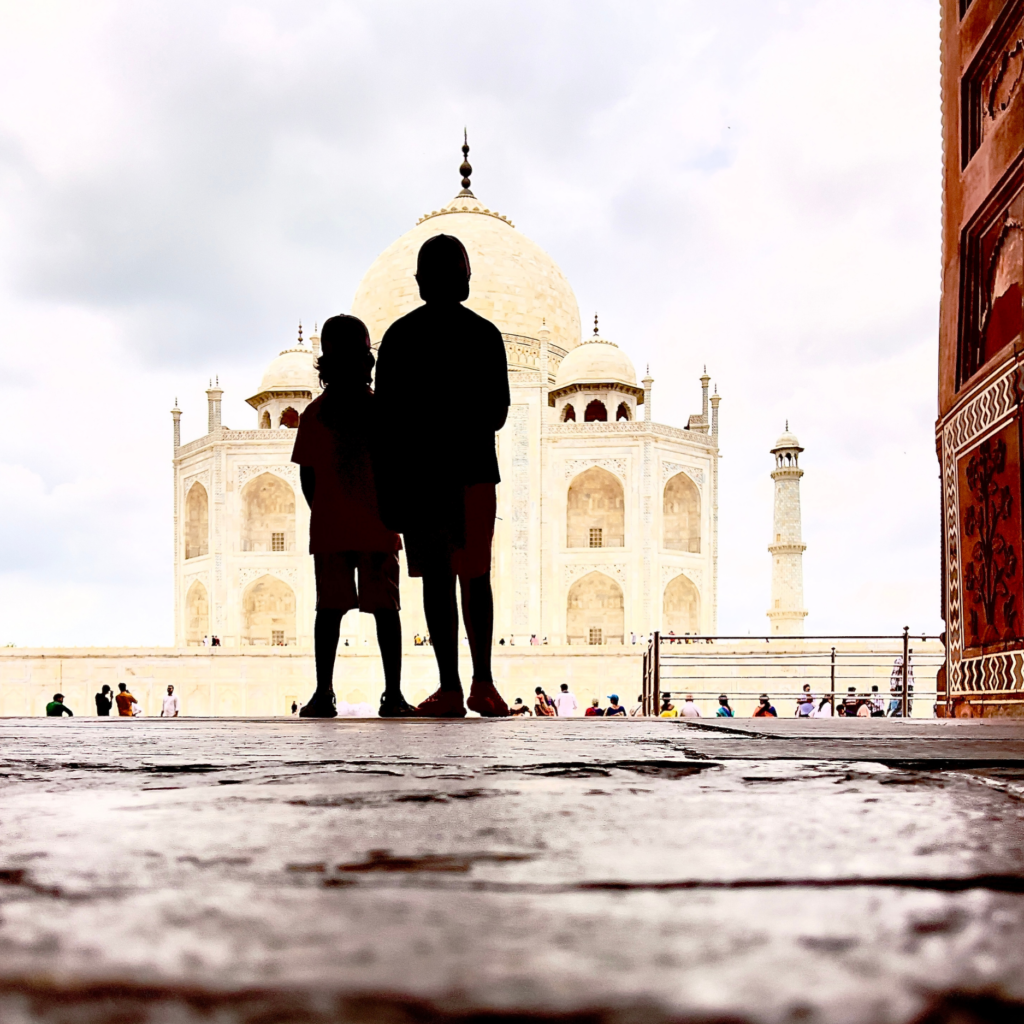
The big sights, you do early. We took our boys to the Taj Mahal in July, when they were around nine and seven. I’ll be honest, we almost wilted. We still loved it, it’s the Taj, but we would have stayed longer and taken a lot more photos if we hadn’t been slowly cooking. What saved us was going straight from there to an air-conditioned restaurant and a cold drink. That’s the rhythm of a summer day on the plains: one big thing early, then get cool, then recover, then go again.
None of this makes summer the season you’d choose first. But it makes it a season you can absolutely take your family through, and come home glad you did.
What about festivals?
A festival can be the best memory of the whole trip or the thing that tips your kids over the edge, and which one you get depends on the festival and on your family.
Diwali, the festival of lights, lands in October or November, and it is genuinely beautiful, lights on every house, sweets everywhere, a whole country celebrating at once. But here’s what the pretty photos leave out: the firecrackers. They run for days, and not politely in the evening either. Expect firecrackers going off at 3am, every single night, the kind that jolt you straight out of sleep. With jet-lagged kids who are already fighting to adjust, that is a real thing to weigh. The firecrackers also drop the air quality in the big northern cities hard, so if anyone in your family has sensitive lungs, know that going in too.
Holi, in March, is the color festival, and it’s pure joy if your kids are the type who would love being pelted with bright powder. It can also be a lot. In open crowds it gets rowdy, and as obvious foreigners you become a target for the color, which thrills some kids and overwhelms others. If you want the experience without the chaos, plenty of hotels run their own family-friendly Holi, which is the version I’d point a first-timer toward.
If you want festival magic without the intensity, the January kite festival, biggest in Gujarat, is a gentler one. The whole sky fills with kites. It’s a visual feast and it doesn’t come with the crowd-crush of the bigger two.
My honest take: don’t bend a first trip around a festival unless you really want that specific one. A festival amplifies everything India already is, the color and the noise and the crowds, which is wonderful when your family is ready for it and too much when they’re not. If there’s one you’ve always dreamed of seeing, build the trip around it on purpose. If not, you are not missing the point of India by skipping them.
So when should you actually go?
If I were telling a friend, it comes down to two questions.
Can you travel in the cool months, October through March? Then go then. That’s the easy, comfortable answer, especially for a first trip with kids, and you don’t need to agonize over which of those months. They’re all good.
Stuck with summer? Then the question stops being when and turns into where and how. Point the trip at the mountains or the south and let the heat be someone else’s problem, or take on the classic route with the early starts and the AC breaks and the fans, and accept that it’s harder but completely doable. We’ve done it both ways, and we’ve never once come home wishing we’d stayed.
The thing I’d want a friend to hear is that the perfect month matters less than people think. India is not one climate and one season. It’s a dozen of each, and the bigger levers are how you pace your days and where you point the trip, not whether you nailed the ideal date on the calendar. The best time to visit India is, honestly, a lot closer to “the time you can actually go” than the guides admit.
And if you’re also wondering whether India is even safe to take your kids to in the first place, here’s the honest answer I’d send you to next: Is India Safe for Kids? An RN’s Honest Answer. For everything else you need to plan your first family trip to India, including safety, food, costs, and where to go, read our full India Family Travel Guide.
What’s next
If you’re working out when to take your own family to India, here are two ways we can help.
Free: The Asia Family Packing Guide
Whenever you end up going, cool season or peak summer, what you pack changes the whole trip. We put together a free guide covering exactly what we bring for our family across India, Nepal, and Vietnam, the handheld fans and cooling towels included. Real items, real reasons, no fluff.
Custom: A Travel Blueprint built for your family
Timing is the easy part. Fitting it to your actual dates, your kids’ ages, the regions that work in your window, and a pace that won’t melt anyone, that’s the part worth getting right. When you’re ready to plan a real trip, we build Custom Asia Travel Blueprints around your specific family. ND brings the firsthand knowledge of growing up in India, and I bring the family travel prep lens and twenty years of going back, in every season. Every Blueprint includes a thirty-minute call so you walk away understanding the why behind every decision, not just the what.