
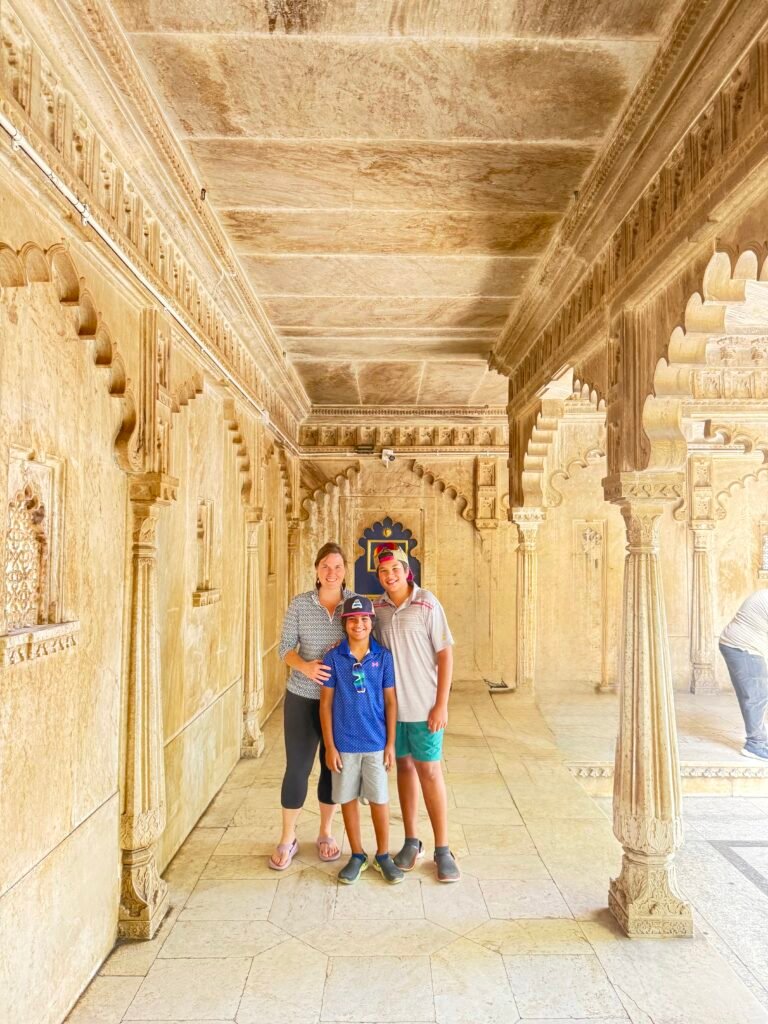
This India family travel guide is the honest version nobody else has written. If you’ve been thinking about taking your family to India and keep not doing it, you’re in the right place. You’re probably overwhelmed. You’ve read other guides and they were either glossy in a way that didn’t help, or so comprehensive they made it feel impossible. The goal of this guide is to share an honest perspective filtered through the years of lived experience and travel we have done in India.
I’m Kelly and I lived in India for nearly two years in my early twenties. I didn’t go on a tour. I rode city buses in Delhi where you couldn’t find standing room and twenty more people got on at the next stop anyways. I got food poisoning, kidney stones, and a broken scapula. I bathed in a river in a village with no running water. I dug holes in fields to bury tampons. I’ve slept on traditional Indian cots under the village stars, but also stayed at luxury hotels like the JW Marriott in Delhi. Even still, my husband ND, who was born and raised in Rajasthan, still reminds me, regularly, that I have no idea about half of India and he’s right. Now, we’ve taken our two boys back five times, proving that India travel with kids is possible and rewarding.
So when I say I know what you’re walking into, I mean it. I also mean this: India will be challenging. It will be frustrating at times. It will be chaotic. It might feel a little unhinged. It will also be beautiful in its own incredible sense if you let it. A prebooked luxury tour will shield you from most of that, which sounds nice until you realize you also got shielded from the actual country.
Here is what I want you to walk away from this page believing. Being scared of this trip is more of a reason to do it, not less. Those fears, of long flights, of different food, of different people, of dirt and poverty you’ve never had to see, are not protecting you from anything. They are limiting your world. They are limiting your growth. They are keeping you in your own little corner of the world. Most of us spend our whole lives in that corner without even realizing it.
This guide is the version I’d give a close friend who told me she’d been thinking about this trip for three years and kept not doing it. Honest. Specific. Comprehensive. Read what’s relevant to your family, skip what isn’t, and come back when you’re ready to plan.
Is It Safe?
The safety question is the one I get first, every time. Before the packing list, before the itinerary, before anything practical. Is it safe? Is it safe for kids? Should I actually be doing this?
Here is the honest answer: yes. With context.
I am an RN. I have lived in India. I have taken my two boys there five times and we are still going back regularly. I have had food poisoning, kidney stones that required surgery in Ajmer, a broken scapula from a fall at a Delhi guesthouse, bed bugs, and lice three times. I say all of that not to scare you but because it matters that the person telling you India is worth it has actually been through the hard parts of it and still came back.
India is not dangerous in the way people imagine when they ask the safety question. There are no active war zones on the tourist circuit. The infrastructure, while imperfect, moves hundreds of millions of people every day. The risks that exist are real but they are manageable with preparation, awareness, and honest expectations.
What India is, and what no other destination I have been to matches, is intense. It is loud. It is crowded. Personal space is not a concept that translates the same way it does in the US. The roads feel chaotic because they are chaotic by American standards, but they have their own logic and people navigate them constantly without incident. The poverty is visible and that visibility is uncomfortable, especially with kids in tow. Discomfort, though, is not danger. Learning to tell the difference between the two is part of what the trip teaches you.
Women traveling in India, including solo, is not the catastrophe the internet sometimes makes it out to be. Common sense applies. Busy public spaces, trusted transport, awareness of your surroundings. The same tools you use anywhere. I navigated India alone at nineteen for two years. I navigated it again with two boys and my husband. Both were fine.
The families who struggle most in India are the ones who expected a sanitized experience. The families who thrive are the ones who came prepared, came curious, and gave themselves permission to be challenged.
For the full breakdown on health considerations, food and water, women’s safety, and what to tell your kids before you go, read our complete guide: [Is India Safe for Kids? An RN’s Honest Answer.]
Will We Get Sick? Is Delhi Belly Real?
Yes, Delhi belly is real. I want to give you the honest answer instead of the one that makes India sound easier than it is.
Gastrointestinal illness is the most common health issue travelers face in India. It is not inevitable, but it is common enough that you should go prepared rather than optimistic. The combination of a different microbial environment, different food handling norms, and the sheer volume of new things your gut is encountering makes some degree of digestive disruption likely for at least one person in your travel party at some point.
That said, I have taken two kids to India five times and we have not had a trip derailed by illness. We have had sick days. We have adjusted plans. We have found that slowing down and resting for a day is sometimes exactly what a trip to India needs anyway.
As an RN, here is how I think about it. The goal is not to avoid all risk. The goal is to reduce unnecessary risk while staying in the actual country you came to experience. Obsessively sanitizing every surface and refusing street food entirely gets you to a place where you have technically visited India without having experienced it. There is a middle ground. It requires some preparation and some common sense, and it is completely findable.
The basics that genuinely make a difference: drink bottled or filtered water, including for brushing teeth. Be thoughtful about raw produce that cannot be peeled. Pay attention to where food is being prepared and how busy the stall is. High turnover means fresher food. Wash hands more than you think you need to. Carry oral rehydration packets. Know what medications you are packing and why.
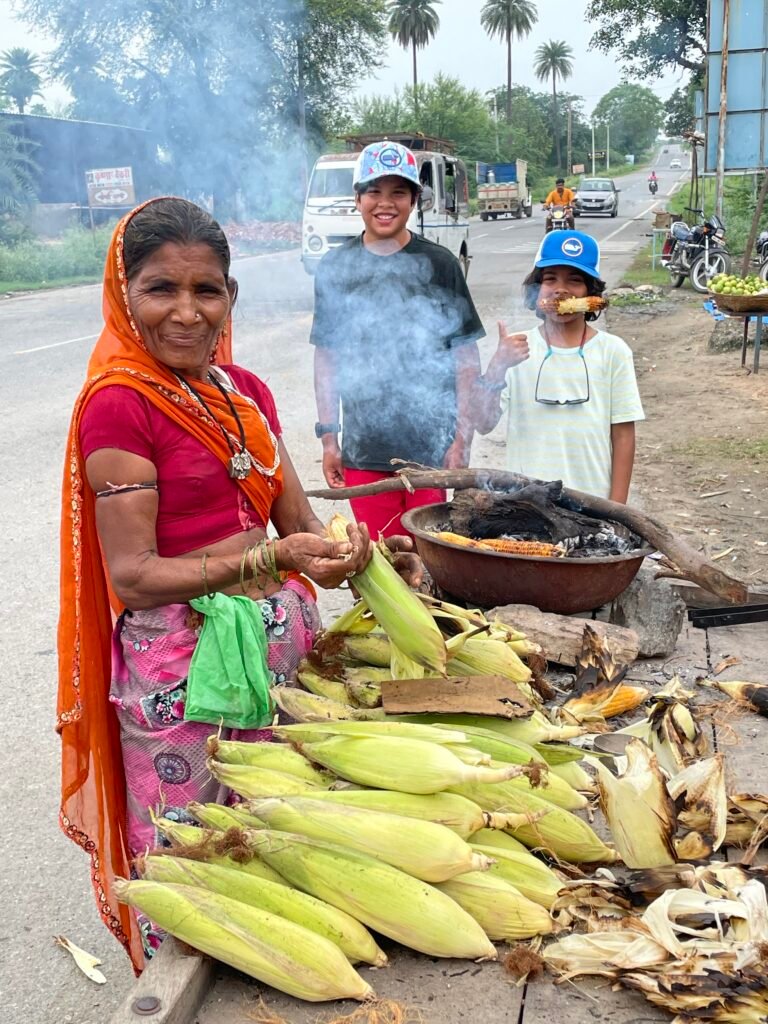
Most families do fine. Kids are resilient in ways that surprise parents. Ours have eaten street corn from a cart on the side of the road in the middle of nowhere, samosas and kachoris from local spots, meals at people’s homes, and the occasional street juice. We eat street food in India. We just choose where wisely. For your first trip, err on the side of caution. The good news is you can find a lot of the same foods you would get from a street cart, chaat, kachoris, samosas, at sit-down restaurants too. You do not have to miss out.
The full health prep playbook, including what to pack in your travel medical kit, how to talk to your doctor before you go, and what to actually do if someone gets sick mid-trip, is coming in a dedicated post. [Coming soon.]
What Will We Eat? What Will the Kids Eat?
The food question almost always contains a version of the same worry: my kids only eat chicken nuggets and plain pasta. Will they starve?
They will not starve. But I want to be honest with you about what you are walking into.
India is a spicy country. Not every dish, but more than you would expect. Things that sound simple and mild on a menu can be heavily spiced. Dishes you might assume are safe can surprise you. If you go in expecting to find a non-spicy version of Indian food you can just hand your kid, you will be frustrated. That is not what India is.
Our boys eat Indian food because we have cooked it at home their entire lives. By the time they got to India, the flavors were not foreign to them. If you have time before your trip, start cooking Indian food at home or try out a few Indian restaurants in your community. Even a few months of exposure makes a real difference in how your kids experience the food when they arrive.
If your kids are picky eaters, the strategy is ordering and packing, not hoping.
On the ordering side: naan, which is the soft flatbread you will find basically everywhere in India, is often the thing small kids latch onto first and it is a completely reasonable thing to let them live on for a few days while they adjust. For dishes like butter chicken or paneer butter masala, ask explicitly for no spice at all. Even at that request level, the food will likely carry some heat because there is a floor most Indian kitchens do not go below. But it is manageable, and those dishes are a reasonable starting point for kids who are willing to try something new.
On the packing side: we traveled with mac and cheese packets and granola bars in the early trips. On long travel days and late arrivals, having something familiar in the bag saved us more than once. We do not pack those things anymore, but for families in the early years of traveling with kids, it is not admitting defeat. It is good planning.
The fallback options worth knowing about: margherita pizza is available at a lot of restaurants, not just big hotels, but always ask for no spice when you order it because smaller places will sometimes automatically add pepper or chili on top. Pizza Hut and McDonald’s are also available in most big Indian cities if you hit a wall. Worth knowing: McDonald’s in India does not serve beef. Cows are sacred in Hinduism and the menu reflects that. You will find chicken nuggets and chicken burgers, which is usually enough to make a tired kid happy, but the classic hamburger is not on the menu. No surprises if you know going in.
For the full breakdown on what to order, how to navigate street food with kids, and region by region differences, we have a dedicated post. [Coming Soon.]

How Will We Adjust? Will the Kids Hate It?
Here is what I want you to know before I answer this: our kids did not love India the first time. They adjusted. They came around. By the end of the trip they did not want to leave. And even in the days when they were not loving it, it was doing the work. That is the honest version of how this goes for most families.
The first 48 hours are the hardest. Jet lag is real, the sensory experience of arriving in India is unlike anywhere else, and kids who are tired and overstimulated will not be at their best. Neither will you. Build that into your expectations before you leave. Do not schedule your most ambitious day for day one or day two. Land, eat something familiar, sleep as much as you can, and give everyone time to arrive before you ask anything of them.
After that window, most kids adjust faster than their parents. Kids are less attached to how they expected things to be. They take cues from the adults around them, which means your attitude in those first few days matters more than you think it does. If you telegraph panic or disgust at the chaos, they will feel that. If you project curiosity, even when you do not fully feel it, they tend to follow.
What wins kids over in India, almost without exception, is the people. Indians are warm toward children in a way that is hard to describe until you have seen it. Your kids will be noticed, welcomed, and fussed over in a way that does not happen in most Western travel. That attention is disarming. It is usually the thing that shifts a reluctant kid into a willing one.
Pacing is everything. India asks a lot of your nervous system even on a good day. Trying to see too much in too little time is the fastest way to break a trip. Build in slow mornings. Build in afternoons where nobody has to be anywhere. A rest day in the middle of a longer trip is not wasted time. It is what makes the second half of the trip possible.
Realistic expectation: some days will be hard. Some moments will be hard. That is not a sign the trip is failing. It is a sign you are actually in India.
The Intensity Nobody Warned You About
No guide is going to fully prepare you for what it feels like to arrive in India for the first time. Not this one either. What I can do is tell you it is a lot, that it is temporary, and that the families who struggle most are the ones who were not told it was coming.
India is busy in a way that does not translate until you are standing in it. The sights, the sounds, and yes, the smells, especially in bigger cities, can be intense in those first few days. People will approach you, especially in tourist areas: drivers, vendors, guides, people selling things you did not come looking for. Kids who have never left their neighborhood will stare at yours. It is not rude. It is curiosity. You learn to move through it calmly and it stops feeling like an assault pretty quickly.
The harder part is what comes next.
In every tourist area in India, if you are not on a big tour bus, you will be approached. By auto rickshaw drivers, by guides offering their services, by people selling water or fans or miniature replicas of whatever you came to see, and by children. Children begging. Mothers holding babies. Kids your kids’ age, sometimes in rags, sometimes without pants.
It is hard. It will break your heart. It may make your kids freeze the first time it happens.
We have given to beggars. We have also walked away. There is no formula. Our rule, if you can call it that, is to listen to our gut. When something inside says to give, we give and we don’t worry about what happens after. When something inside says to walk away, we do, even when it hurts. We have also found that some of the most meaningful giving we have done in India and Nepal has been to people who were not asking. The kids carrying trash to sort for a few rupees. The woman selling tea on the street with a story that stayed with us. Those are the moments where generosity has felt most aligned for our family.
Talk to your kids about all of it. Before, during, and after. Ours have processed real grief about what they have seen. They have also asked harder, better questions about the world they live in than any school could have taught them. That trade-off is part of what made the trips worth it.
How Long Should We Go?
Two weeks is the minimum. If you are flying from the US to India, you are looking at roughly 18 to 24 hours of travel time depending on your route and layovers. That is not a quick trip. The jet lag is significant and it runs in the wrong direction, meaning your body clock will fight you harder coming home than going. You need time on the ground to actually be present before you have to turn around and leave.
Two weeks gives you that, but not a lot of extra. Budget three to four days at the front end for jet lag and orientation, and a day or two at the back end to rest before the return flights. What is left in a two-week trip is about nine to ten days of actual travel. That is enough for a focused, well-planned itinerary in one or two regions. It is not enough to try to see everything.
Three weeks is the sweet spot for most families. You have room to pace yourself, room for a slow day when someone needs it, and room to go a little deeper in the places you visit instead of rushing through a checklist. India rewards slower travel. The best moments tend to happen when you are not in a hurry.
Four weeks or longer is worth considering if you can make it work, especially if you are pairing India with Nepal or Vietnam. The cost of the flights is the same whether you stay two weeks or four. The incremental daily cost of being in India is low compared to most international destinations. The math often favors staying longer.
One thing we tell families consistently: almost everyone comes home wishing they had stayed longer. Very few people come home wishing they had shortened the trip. If you are on the fence between two weeks and three, go three.
For a full breakdown of how to think about length by destination, family age, and itinerary type, we have a dedicated post with specific day-by-day recommendations. [Coming soon.]
When Should We Go?
The short answer is October through March. That is the window when the weather in most of India is cooperative enough for families to travel comfortably, and it is when the majority of first-time visitors should plan their trip.
Here is why the window matters. Indian summers, particularly in the north where most first-time families go, are brutal. April and May temperatures in Rajasthan and Delhi regularly exceed 110 degrees Fahrenheit. That is not a trip. That is an endurance test. The monsoon follows, running roughly June through September, bringing heavy rain and humidity across most of the country. Traveling in monsoon is possible and has its own beauty, but it is not what we recommend for a first family trip.
October through March avoids both. The north is dry, temperatures are manageable, and the skies are clear. December and January are peak season, which means crowds at major sites and higher prices, but also the most reliably comfortable weather. If you are flexible, November and February are quieter and often better value.
A note on festivals. If your trip overlaps with Diwali in October or November or Holi in March, go in with eyes open. Both are visually striking and culturally significant. They also amplify everything that is already intense about India. Crowds are bigger, cities are louder, and the chaos dial gets turned up. For a first-time family, neither is necessarily the asset it sounds like on paper. If you land in one, enjoy it for what it is. We would not plan a first trip around either.
South India follows a somewhat different pattern and can be visited outside the October to March window more comfortably than the north. If your itinerary includes Kerala or Tamil Nadu, the timing conversation gets more nuanced.
The one consistent advice we give regardless of when you go: book flights and accommodation earlier than you think you need to. India’s peak season fills up, and the best properties in popular areas go fast.
For a full seasonal breakdown by region, including what to expect month by month, read our complete guide: [Best Time to Visit India With Kids: An Honest Seasonal Guide.]
Where Should We Go on a First Family Trip?
India is enormous. It is not one place. The food, the language, the landscape, and the culture shift dramatically from region to region in ways that can make planning feel overwhelming. If this is your first trip with your family, our recommendation is straightforward: start in Rajasthan.
Here is why. Rajasthan is where ND was born and raised, so we know it better than anywhere else in the country. It is also, practically speaking, the region that tends to work best for first-time family visitors. The tourist infrastructure is well developed. The sights are genuinely spectacular in a way that lands even with kids who do not yet have a frame of reference for what they are seeing. Forts, palaces, desert, camels, and color everywhere. Rajasthan delivers the India that most people picture when they picture India, and it delivers it in a way that is navigable.
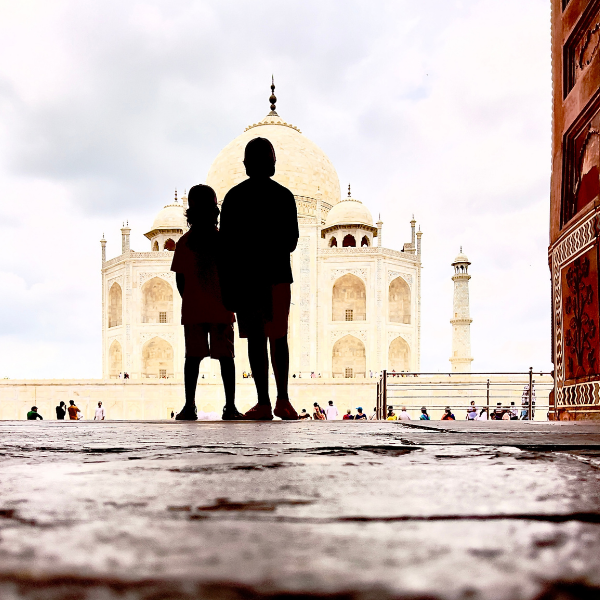
Most first-time families move through some version of the Golden Triangle, which connects Delhi, Agra, and Jaipur. It is a classic route for a reason. Delhi is almost certainly where you will land, Agra is where the Taj Mahal is, and Jaipur is the gateway into Rajasthan. From Jaipur you can go deeper: Udaipur, Jodhpur, Jaisalmer. Each city has its own character and all of them are worth time.
A note on Delhi. It is intense, it is chaotic, and it is not the easiest entry point for a family that has never been to India. It is also unavoidable as a hub and it has things worth seeing. Our advice is not to start with too many days in Delhi on your first trip. Get oriented, see what you came to see, and move toward Rajasthan where the pace tends to suit families better.
Mumbai is worth a trip on its own at some point. South India, which includes Kerala, Tamil Nadu, and Karnataka, is genuinely beautiful and operates at a different pace than the north. Both are better as second or third trip destinations, not because they are harder, but because Rajasthan gives you the best return on a first visit.
We have a full guide to first-time India itineraries by trip length and family age coming soon. [Coming soon.]

Pre-Trip Prep
This section covers the practical logistics that catch first-time India travelers off guard. None of it is complicated once you know it. All of it is worth knowing before you leave.
Visas. US citizens can apply for an Indian e-visa online before departure. The process is straightforward and does not require going to a consulate. Apply at least two weeks before your trip, ideally more. Every member of your family, including children, needs their own visa. India also now requires a digital e-Arrival Card to be completed online before you land. Physical paper forms are no longer accepted. The form must be submitted within 72 hours of your travel and you will need to present the generated QR code upon arrival. Do it for every traveler in your group and save the QR code on your phone before you get to the airport. It sounds like a small thing but skipping it creates a real problem when you land. We will walk through the full process in our trip planning post. [Coming soon.]
Vaccinations. Talk to a travel medicine doctor or your family physician at least four to six weeks before departure. Some recommended vaccines for India require multiple doses spaced out over time, so last-minute appointments limit your options. We are not going to tell you which specific vaccines to get because that conversation belongs with your doctor and depends on your family’s health history and your specific itinerary. What we will say is do not skip this appointment.
Women’s safety. I traveled India alone for nearly two years starting at nineteen. I have navigated markets, buses, trains, and cities solo, and I have had moments that required awareness and a quick decision. Once in Delhi a man followed me through a market and I stepped into a shop and talked to the shopkeeper until he left. That is the reality, and it is manageable. The short version: solo women travel India regularly and successfully. Use busy public spaces, use trusted transport, stay aware of your surroundings, and trust your gut when something feels off. The same instincts you use at home apply here, just turned up a notch.
SIM cards. Getting a local SIM card is one of the best things you can do for a smoother trip. Airtel and Jio are the two main carriers. The easiest place to get one is at the airport when you land, either Delhi or Mumbai. The carrier kiosks are set up to handle foreign visitors and the process is straightforward there. If you try to get a SIM after you leave the airport, it becomes significantly harder to navigate as a foreigner. You will need your passport to purchase, so have it out and accessible. Local data in India is cheap and having it makes navigation, translation, and communication dramatically easier from day one.
ATMs and cash. India is still largely a cash economy, especially outside of big cities and major hotels. A few things to know before you go. ATMs in India typically have a per-transaction limit of around 10,000 rupees, which is roughly 120 US dollars. You may need to make multiple withdrawals. ATMs also break down more regularly than you are probably used to, and when one does not work, the answer is simply to find another one. Get your cash from ATMs in India rather than exchanging money at home. The rates are better. Smaller restaurants, local markets, and transportation will often need cash even if the sign suggests otherwise. Carry more than you think you need.
For a full pre-trip planning checklist including packing, documents, and what to do in the weeks leading up to departure, we have a dedicated post coming. [Coming soon.]
The Flights and the Jet Lag
Flying from the US to India is a long haul. Depending on your departure city and routing, you are looking at 18 to 24 hours of total travel time, usually with one layover. Common routes go through Europe or the Middle East. Neither is dramatically better than the other. What matters more is choosing flights that give your family the best shot at arriving functional.
India runs on a single time zone, Indian Standard Time, which sits at UTC plus 5 hours and 30 minutes. That half-hour offset is unusual and worth noting because it means India does not align neatly with any US time zone on a clock. From the East Coast you are looking at roughly a 9.5 hour difference. From the West Coast, closer to 12.5 hours. Traveling east across that many time zones is harder on your body than going west, and the return trip tends to be rougher than the outbound one.
For the flights themselves: book seats together, pack more entertainment and snacks than you think you need, and lower your expectations for how much sleep anyone will actually get. Long-haul flying with kids is a grind regardless of how well you prepare. The goal is to arrive tired but not destroyed.
Jet lag with kids is unpredictable. Some children adjust faster than expected. Others take a full week. The strategies that tend to help: start shifting bedtimes a few days before departure, get outside in natural light as soon as you land, and resist the urge to nap in the middle of the day when you arrive. Stay up until a reasonable local bedtime even when everything in your body says otherwise. Melatonin can help with the first few nights.
Landing realities: Delhi’s Indira Gandhi International Airport is more modern and manageable than many first-timers expect. The challenge is not the airport, it is what happens when you walk out of it. Go back to the intensity section above. Everything in that section applies most acutely in the first hour after you land.
Build recovery time into the front of your itinerary. We said it in the length section and we will say it again here because it is the advice most families ignore and then wish they had taken.
For a full guide to booking long-haul flights with kids, points and miles strategies for getting to India, and a day-by-day jet lag recovery plan, we have a dedicated post coming. [Coming Soon.]
What Does It Cost?
India is one of the most affordable international destinations for a US family once you are on the ground. The sticker shock, if there is any, almost always comes from the flights. Understanding that split is the key to budgeting this trip accurately.
Flights from the US to India for a family of four will typically run between $4,000 and $8,000 round trip depending on your departure city, routing, time of year, and how far in advance you book. Peak season around Christmas and New Year pushes toward the top of that range. Shoulder months like November and February offer better value. If you are open to using points and miles, flights to India are one of the better redemptions available, and a family of four in economy can often be covered for a fraction of what cash tickets would cost. We go deep on the math in a dedicated post. [Coming soon.]
Once you land, the daily cost of traveling in India is low by US standards. A comfortable mid-range hotel runs $60 to $120 per night in most cities. A full meal for a family at a good local restaurant can cost $10 to $20. Private drivers, which we recommend over navigating transport on your own for a first trip with kids, are affordable by any measure. Entrance fees at major sites are reasonable, though there is typically a higher rate for foreign visitors than for Indian nationals at most monuments including the Taj Mahal.
Budget travel in India is possible and some families do it. Traveling with kids changes the calculus. A private driver instead of public transport, a hotel with reliable air conditioning, and access to a kitchen or room service on rough nights are worth paying for. We are not suggesting luxury across the board. We are suggesting strategic comfort in the places that protect your trip.
A realistic all-in budget for a two week family trip to India, including flights, accommodation, food, transport, and activities, runs somewhere between $8,000 and $15,000 for a family of four depending on your choices. That range is wide because the choices are wide. The Custom Blueprint is where we help you figure out what that number looks like for your specific family and itinerary.
For a full cost breakdown by city and travel style, read our dedicated post. [Coming Soon.]
Why Bother? What Makes India Worth the Effort?
You have read twelve sections of honest, sometimes uncomfortable information about what it takes to bring a family to India. So let me answer the question I know you are sitting with: is it actually worth it?
Yes. Without hesitation.
India is not worth it because it is easy. It is worth it because it is not. The places that ask something of you are the places that give something back. India asks a lot. What it gives back is harder to quantify but impossible to miss once you have experienced it.
It gives your kids a reference point for the world that no classroom, no documentary, and no other destination has ever given ours. They have seen poverty that is real and close, not filtered through a screen. They have been welcomed by strangers who had every reason not to care about them and chose warmth anyway. They have eaten food with their hands at a family table in Rajasthan and come home changed in ways that are still unfolding. Our boys ask different questions now. They hold their own lives differently. That happened in India.
It gives you, as a family, a shared experience that is genuinely hard to replicate. Hard trips bond people. The day everything went sideways in a city you could barely navigate, and you figured it out anyway, becomes a story your family tells forever. The morning you watched the sun rise over something that made everyone go quiet becomes one of those moments you return to when you need to remember what matters.
And India itself. The color of it. The noise of it. The way a market feels at dusk when the light goes golden and everything smells like spice and smoke. The hospitality of people who will invite you in for chai before you have finished explaining who you are. The forts and the temples and the desert and the chaos and underneath all of it, an ancient, layered, endlessly surprising country that rewards the people who show up for it.
Being scared of this trip is more of a reason to do it, not less. Most families spend years thinking about it and not going. The ones who go, often come home and immediately start planning the next one.
If you are ready to start planning, our free Asia Family Packing Guide is a good first step. It covers everything we actually pack for a family trip to India and it is free. [Link to packing guide.]
And when you are ready to stop planning on your own and build something real, that is what the Blueprint is for. [Link to Blueprint.]
Written by Kelly Damor, RN/BSN. Founder of Go Boundless Travel.